Auteur/autrice : Admin202603

  • Abraham : Messager Originel de l’Islam


    Louange à Dieu ! Il n’y a pas d’autre dieu que Dieu.

    Un des mythes très répandus est celui selon lequel Mohammed était le fondateur de l’Islam. Bien que l’Islam, soumission totale à Dieu seul, soit la seule religion reconnue par Dieu depuis l’époque d’Adam (3:19, 85), Abraham est mentionné dans le Coran comme le premier utilisateur du mot « Islam » et celui qui nous a appelés « Musulmans », c’est-à-dire Soumis (22:78). La soumission exemplaire d’Abraham à Dieu est démontrée par sa fameuse volonté de sacrifier son fils unique, Ismaël, quand il crut que c’était un ordre de Dieu. Il se trouve en fait qu’un tel ordre était de Satan.

    Dieu n’a Jamais Ordonné à Abraham de Sacrifier son Fils

    Dieu est le Plus Miséricordieux. Il ne viole jamais Sa propre loi (7:28). Quiconque croit que le Tout Miséricordieux a ordonné à Abraham de tuer son fils ne peut absolument pas aller au Paradis de Dieu. Une si mauvaise pensée à propos de Dieu est gravement blasphématoire. Nulle part dans le Coran nous ne voyons que Dieu a ordonné à Abraham de tuer son fils. Au contraire, Dieu est intervenu pour sauver Abraham et Ismaël du complot de Satan (37:107), et Il a dit à Abraham : « Tu as cru au rêve » (37:105). Sans aucun doute, c’était un rêve inspiré par Satan. La loi irrévocable de Dieu est: « DIEU ne préconise jamais le péché » (7:28).

    Millat Ibrahim

    L’Islam est appelé « Millat Ibrahim » (la religion d’Abraham) partout dans le Coran (2:130, 135; 3:95; 4:125; 6:161; 12:37-38; 16:123; 21:73; 22:78). De plus, le Coran nous informe que Mohammed était un adepte (suiveur) d’Abraham (16:123).

    En raison de l’ignorance générale du fait qu’Abraham était le messager à l’origine de l’Islam (Soumission), beaucoup de soi-disant Musulmans défient Dieu :
    « Si le Coran est complet et pleinement détaillé (comme déclaré par Dieu), où pouvons-nous trouver le nombre de Rakahs (unités) dans chaque prière de contact (Salat) ? ».

    Nous apprenons du Coran que toutes les pratiques religieuses de l’Islam étaient déjà établies avant la révélation du Coran (8:35, 9:54, 16:123, 21:73, 22:27, 28:27). Le verset 16:123 est la preuve directe que toutes les pratiques religieuses de l’Islam étaient intactes au moment où Mohammed est né. Mohammed a été enjoint de « suivre la religion d’Abraham. » Si je vous demande d’acheter une TV couleur, cela suppose que vous sachiez ce qu’est une TV couleur. De façon similaire, quand Dieu ordonna à Mohammed de suivre les pratiques d’Abraham (16:123), ces pratiques devaient bien être connues.

    L’acceptation universelle des pratiques religieuses

    Une autre preuve de la divine préservation des pratiques Islamiques données à Abraham est l’« Acceptation Universelle » de ces pratiques. Il n’y a pas de controverses concernant le nombre de Rakahs dans les cinq prières quotidiennes. Ceci prouve la préservation divine de la Salat. Le code mathématique du Coran confirme le nombre de Rak`ahs dans les cinq prières, respectivement 2, 4, 4, 3, et 4. Le nombre 24434 est un multiple de 19.

    Le Coran traite seulement des pratiques qui ont été déformées. Par exemple, l’ablution qui était déformée, est rétablie dans le verset 5:6 dans les quatre étapes d’origine. Le ton de la voix durant les prières de contact (Salat) était déformé – beaucoup de Musulmans prient silencieusement. Ceci a été corrigé dans le Coran, verset 17:110. Le jeûne du Ramadan a été modifié dans le Coran pour permettre les relations sexuelles durant la nuit (2:187). La Zakat a été rétablie en 6:141, et le Hadj a été rétabli aux quatre mois corrects (voir Appendice 15).


    Sermon du Vendredi basé sur l‘Appendice 9 de la Traduction Française Autorisée du Coran par Rashad Khalifa (1989)


    Pour plus d’informations :

    Old Message, New Messenger

    The Three Messengers of Islam

    Role of the Prophet Muhammad

    Rejoignez-nous pour écouter nos réunions du vendredi en ligne chaque vendredi.

  • Le Mythe de l’Intercession


    Louange à Dieu ! Il n’y a pas d’autre dieu que Dieu.

    Croire que quiconque, autre que Dieu, peut intercéder en notre faveur pour que nos péchés soient pardonnés ou que nos souhaits soient exaucés, revient à ériger des partenaires avec Dieu. C’est de l’idolâtrie. Le Coran proclame que : « Toute intercession appartient à Dieu » (39:44), qu’il n’y aura « aucune intercession au Jour du Jugement » (2:254).

    Le mythe de l’intercession est l’une des ruses les plus efficaces de Satan pour duper des millions de gens à pratiquer l’idolâtrie. Des millions de Chrétiens croient que Jésus intercèdera pour eux auprès de Dieu, et des millions de Musulmans croient que Mohammed intercèdera en leur faveur. En conséquence, ces gens idolâtrent Jésus et Mohammed.

    Le concept de l’intercession est totalement illogique. Ceux qui croient en l’intercession de Mohammed, par exemple, prétendent qu’il demandera à Dieu de leur pardonner et de les admettre au Paradis. Ils imaginent Mohammed choisissant les candidats pour son intercession le Jour du Jugement. Lorsque vous demandez à ceux qui croient en l’intercession : « Comment Mohammed reconnaîtra-t-il ceux qui méritent son intercession ? » Ils vous disent : « Dieu lui dira ! » Selon ce concept, une personne ira auprès de Mohammed et demandera son intercession. Mohammed demandera alors à Dieu si cette personne mérite son intercession ou pas. Dieu informera Mohammed que la personne a mérité d’aller au Paradis. Mohammed alors se retournera et dira à Dieu que la personne mérite d’aller au Paradis ! Le blasphème est évident ; ceux qui croient en l’intercession font de Dieu un secrétaire de leur idole Mohammed. Dieu soit glorifié.

    L’intercession des habitants du Paradis

    Puisque le Coran est le livre le plus précis, il reconnaît que chaque personne au Paradis intercèdera en faveur de ceux qu’elle aime : « S’Il te plait Dieu, admets ma mère au Paradis. » Cette intercession n’opèrera que si la mère de la personne mérite d’aller au Paradis (2:255, 20:109, 21:28). Ainsi, l’intercession, bien qu’elle ait lieu de cette manière, est totalement inutile.

    Nous apprenons du Coran qu’Abraham, le serviteur bien-aimé de Dieu, ne pouvait pas intercéder en faveur de son père (9:114). Noé ne pouvait pas intercéder en faveur de son fils (11:46). Mohammed ne pouvait pas intercéder en faveur de son oncle (111:1-3) ou de ses proches (9:80). Comment quelqu’un peut-il penser qu’un prophète ou un saint intercèdera en faveur d’un parfait étranger ?! Voir 2:48, 123 ; 6:51, 70, 94 ; 7:53 ; 10:3 ; 19:87 ; 26:100 ; 30:13 ; 32:4 ; 36:23 ; 39:44 ; 40:18 ; 43:86 ; 53:26 & 74:48. L’intercession de Mohammed se trouve dans le verset 25:30.


    Sermon du Vendredi basé sur l‘Appendice 8 de la Traduction Française Autorisée du Coran par Rashad Khalifa (1989)


    Pour plus d’informations :

    Why Was the Quran Revealed in Arabic?

    The Mathematical Miracle of the Quran

    Quran: All You Need for Salvation

    Rejoignez-nous pour écouter nos réunions du vendredi en ligne chaque vendredi.

  • Pourquoi Avons-Nous été Créés ?


    Louange à Dieu ! Il n’y a pas d’autre dieu que Dieu.

    Nous sommes dans ce monde parce que nous avons commis un horrible crime, et cette vie est notre dernière chance de nous racheter, de dénoncer notre crime, et de rejoindre le royaume de Dieu.

    Tout a commencé il y a quelques milliards d’années quand « une querelle éclata dans la Société Céleste » (38:69). Une des créatures de haut rang, Satan, entretint des pensées hautaines selon lesquelles les pouvoirs que Dieu lui avait donnés le qualifiaient pour être un dieu en plus de Dieu. Il défia ainsi l’autorité absolue de Dieu. Non seulement l’idée de Satan était un blasphème, mais elle était également fausse – seul Dieu, et personne d’autre, détient les qualifications et l’habilité pour être un dieu. A la suite du blasphème de Satan, une division se produisit dans la Société Céleste, et tous les sujets du royaume de Dieu furent classifiés en quatre catégories :

    1. Les anges : Créatures qui ont soutenu l’autorité absolue de Dieu.
    2. Les animaux : Créatures qui se sont rebellés mais ont ensuite accepté l’invitation de Dieu à se repentir.
    3. Les djinns : Créatures qui étaient d’accord avec Satan, qu’il est capable d’être un « dieu ».
    4. Les humains : Créatures qui ne se sont pas décidés ; ils échouèrent à faire un choix ferme concernant l’autorité absolue de Dieu.

    Le Plus Miséricordieux

    Les anges s’attendaient à ce que Dieu bannisse les créatures qui n’ont pas soutenu Son autorité absolue. Mais Dieu est le Plus Miséricordieux ; Il décida de nous donner une chance de dénoncer notre erreur, et informa les anges qu’Il savait ce qu’ils ne savaient pas (2:30). Dieu savait que certaines créatures méritaient une chance d’être rachetées.

    Si vous prétendez être capable de faire voler un avion, le meilleur moyen de tester vos prétentions est de vous donner un avion et de vous demander de le faire voler. C’est précisément ce que Dieu a décidé de faire en réponse à la prétention de Satan. Dieu créa sept immenses univers, puis informa les anges qu’Il désignait Satan comme dieu sur la toute petite poussière appelée « Terre » (2:30). Les récits coraniques liés à la désignation de Satan comme « dieu » temporaire (36:60) confirment l’Écriture précédente.

    Toi, Lucifer, as dit dans ton cœur: « J’escaladerai les cieux. Au-dessus des étoiles de Dieu. J’érigerai mon trône.
    Je m’assiérai sur le Mont de la Congrégation dans les recoins du Nord. Je monterai au-dessus du sommet des nuages ;
    Je serai comme le Plus Haut ! »

    [Isaïe 14:13–15]

    Le diable emmena alors Jésus à une très haute montagne et étala devant lui tous les royaumes du monde dans leur magnificence, promettant : « Tout cela je te le donnerai, si tu te prosternes en hommage devant moi. » A ceci, Jésus lui dit : « Va-t’en, Satan ! Dans l’Écriture il est dit : ‘Tu adoreras le Seigneur ton Dieu ; Lui Seul tu vénèreras.’ »

    [Matthieu 4:8-10] & [Luc 4:5-8]

    Le plan de Dieu

    Le plan de Dieu exigeait de créer la mort (67:1-2), puis d’amener les humains et les djinns dans ce monde. Ainsi, ils recommencent à zéro sans aucun préjugé, et exercent la liberté totale de se conformer à l’autorité absolue de Dieu ou la théorie polythéiste de Satan. Pour prendre cette décision cruciale, chaque être humain reçoit un message de Dieu préconisant Son autorité absolue, ainsi qu’un message de Satan poussant à son principe polythéiste.

    Pour nous donner une longueur d’avance, le Plus Miséricordieux a réuni devant Lui tous les êtres humains, avant de nous envoyer dans ce monde et nous a fait témoigner que Lui seul est notre Seigneur et Maître (7:172) Ainsi, soutenir l’autorité absolue de Dieu est un instinct naturel qui est une part intégrante de tout être humain. Après avoir mis à mort les rebelles, les âmes des humains et des djinns furent placées dans un réceptacle spécial. Dieu alors créa les corps appropriés pour loger les âmes des djinns et des humains durant la période test.

    Le corps des djinns et des humains

    Le premier corps djinn a été fait de feu, et Satan fut assigné à ce corps (15:27). Le premier corps humain a été fait de matière terrestre, l’argile (15:26), et Dieu assigna la première âme humaine à ce corps. Le plan divin nécessitait que les anges servent les humains sur terre – les garder, diriger le vent et la pluie pour eux, distribuer les provisions, etc.

    Ce fait est déclaré dans le Coran de manière allégorique : « Votre Seigneur dit aux anges : ‘Tombez prosternés devant Adam’ ». Satan bien-sûr refusa d’avoir quoi que ce soit avec le fait de servir la race humaine (2:34, 7:11, 17:61, 18:50, 20:116).

    Adam au Paradis

    Alors que le corps d’Adam restait sur terre, la vraie personne, l’âme, était admise au Paradis dans l’univers le plus excentré. Dieu donna à Adam certains commandements, incarnés par l’arbre interdit, et Satan fut désigné comme le compagnon d’Adam pour délivrer à Adam son message satanique. Le reste fait partie de l’histoire. Chaque fois qu’un être humain naît, une personne humaine est assignée au nouveau bébé à partir du réceptacle des âmes. Dieu attribue les âmes selon Sa connaissance (28:68). Chaque âme mérite d’être affectée à un certain corps et de vivre dans certaines circonstances. Dieu seul sait quelles âmes sont bonnes et quelles âmes sont mauvaises. Nos enfants sont destinés à nos maisons conformément au plan de Dieu.

    Une âme djinn indépendante est également assignée au nouvel être humain pour représenter l’opinion de Satan. Tandis que le corps physique d’un djinn est reproduit à partir de parents djinns, l’âme djinn est celle d’un individu indépendant. Les djinns sont les descendants de Satan (7:27, 18:50). Le djinn affecté reste avec l’être humain de la naissance à la mort, et sert comme principal témoin au Jour du Jugement (50:23). Un débat continuel prend place dans nos têtes entre l’âme humaine et l’âme djinn jusqu’à ce que les deux soient convaincus d’un point de vue.

    Le Péché Originel

    Contrairement à la croyance commune, le « Péché Originel » n’était pas la violation de la loi de Dieu par Adam quand il mangea de l’arbre interdit. Le péché originel était notre échec à soutenir l’autorité absolue de Dieu durant la Grande Querelle. Si la personne humaine convainc son compagnon djinn de dénoncer ce péché originel, et de se conformer à l’autorité absolue de Dieu, les deux créatures sont rachetées au royaume éternel de Dieu le Jour du Jugement. Mais si le compagnon djinn convainc l’être humain de se conformer aux opinions idolâtres de Satan, alors les deux créatures sont exilées pour toujours du royaume de Dieu.

    Pour promouvoir son point de vue, Satan et ses représentants préconisent l’idolâtrie de créatures impuissantes telles que Mohammed, Jésus, Marie et les saints. Puisque nous sommes ici en raison de nos tendances polythéistes, la plupart d’entre nous sont des proies faciles pour Satan.

    L’incompétence de Satan

    L’incompétence de Satan en tant que « dieu » a déjà été démontrée par la prévalence du chaos, de la maladie, des accidents, de la misère et des guerres partout dans son domaine (36:66). D’un autre côté, les êtres humains qui dénoncent Satan, se conforment à l’autorité absolue de Dieu, et s’abstiennent d’idolâtrer des créatures impuissantes et décédées comme Jésus et Mohammed, sont rétablis dans la protection de Dieu – ils jouissent d’une vie parfaite ici dans ce monde et pour toujours.

    Parce que notre vie dans ce monde est une série de test conçus pour exposer nos idées polythéistes, l’adoration d’idoles est la seule offense impardonnable (4:48, 116). Le monde est divinement conçu pour manifester notre décision à soutenir l’autorité absolue de Dieu, ou les opinions idolâtres de Satan (67:1-2). Le jour et la nuit changent constamment pour tester notre volonté à nous conformer aux lois de Dieu en observant la Prière de l’Aube et en jeûnant durant les jours les plus chauds et les plus longs. Seuls ceux qui sont totalement certains de l’autorité absolue de Dieu sont rachetés (26:89).


    Sermon du Vendredi basé sur l‘Appendice 7 de la Traduction Française Autorisée du Coran par Rashad Khalifa (1989)


    Pour plus d’informations :

    Why Are We Here?

    King of Efficiency

    The Myth of Intercession

    Rejoignez-nous pour écouter nos réunions du vendredi en ligne chaque vendredi.

  • La Grandeur de Dieu


    Louange à Dieu ! Il n’y a pas d’autre dieu que Dieu.

    Nous apprenons du verset 39:67 que la grandeur de Dieu est bien au-delà de l’entendement humain – le verset dit que les sept univers sont tous « pliés dans la main de Dieu ».

    Soutenu par le formidable code mathématique du Coran, on nous apprend que notre univers est le plus petit et le plus concentrique (interne) des sept univers (41:12, 55:33, 67:5, 72:8–12). Dans le même temps, nos avancées scientifiques nous ont montré que notre galaxie, la Voie Lactée, fait 100 000 années-lumière de large, et que notre univers contient un milliard de ces galaxies et un milliard de trillions d’étoiles, sans compter les décillions de corps célestes. On estime que notre univers couvre des distances de plus de 93 000 000 000 années-lumière.

    Comptez les Étoiles !

    Si nous ne prenions qu’un quintillion [1 000 000 000 000 000 000] d’étoiles et les comptions simplement [de 0 à 1 quintillion], un décompte par seconde, jour et nuit, ceci prendrait 32 milliards d’années (plus que l’âge de l’univers). Ceci représente la durée que cela prendrait pour simplement les « compter ». Mais Dieu les a « créées ». Telle est la grandeur de Dieu.

    Nous pouvons apprécier l’immensité de notre univers si nous nous imaginons faire une odyssée spatiale. Quand nous quittons la planète Terre en allant vers le soleil, à la vitesse de la lumière, nous atteignons le soleil après 93 000 000 miles (150 000 000 km) et 8 minutes. Cela nous prendrait plus de 50 000 ans, à la vitesse de la lumière, pour sortir de notre galaxie. De la limite extérieure de la Voie Lactée, notre planète Terre est invisible. Même le plus puissant télescope ne peut détecter notre minuscule « Terre ».

    Nous devrions passer plus de 2 000 000 d’années à la vitesse de la lumière pour atteindre notre galaxie voisine. Au moins 10 000 000 000 années, à la vitesse de la lumière, doivent s’écouler avant d’atteindre la limite extérieure de notre univers. De la limite extérieure de notre univers, même la Voie Lactée est comme un grain de poussière dans une vaste pièce.

    Les sept univers

    Le second univers englobe notre univers. Le troisième univers est plus grand que le second, et ainsi de suite. Plus précisément, notre univers devrait être considéré comme le septième univers, entouré par le sixième, lequel est entouré par le cinquième, et ainsi de suite. Pouvez-vous vous imaginer l’immensité du premier et du plus excentré des univers ? Il n’existe aucun nombre pour décrire la circonférence du premier univers. Cette immensité incompréhensible est « à l’intérieur du poing de Dieu ». De la limite extérieure du plus excentrique univers, où est la planète Terre ? Quelle importance a-t-elle ? Sur le grain infinitésimal appelé Terre, ont vécu de minuscules créatures telles que Marie, Jésus, et Mohammed. Pourtant, certaines personnes érigent ces humains impuissants en dieux !

    La grandeur de Dieu est non seulement représentée par le fait qu’Il tient les sept univers dans Sa main, mais aussi par le fait qu’Il contrôle pleinement chaque atome, jusqu’aux composantes subatomiques, partout dans l’univers plus grand (6:59, 10:61 & 34:3).


    Sermon du Vendredi basé sur l‘Appendice 6 de la Traduction Française Autorisée du Coran par Rashad Khalifa (1989)


    Pour plus d’informations :

    The First Pillar of Islam (Submission): “Laa Elaaha Ellaa Allah” (No god except God)

    God’s Usage of the Plural Tense

    Who Is Your God?

    Rejoignez-nous pour écouter nos réunions du vendredi en ligne chaque vendredi.

  • Le Paradis et l’Enfer


    Louange à Dieu ! Il n’y a pas d’autre dieu que Dieu.

    En plus de leur sens littéral, les descriptions du Paradis et de l’Enfer partout dans le Coran sont allégoriques. Et le Coran nous le dit, chaque fois que de telles descriptions apparaissent comme déclarations indépendantes, non pas dans un sujet d’ordre général. Voir 2:24–26, 13:35, et 47:15. Le mot « Mathal » (allégorie) est utilisé dans ces versets. Linguistiquement, le mot « Mathal » dans ces versets peut être retiré, et nous avons toujours de parfaites phrases. Mais il est là parce que les descriptions du Paradis et de l’Enfer sont allégoriques.

    Ce que le Paradis et l’Enfer sont réellement est bien au-delà de notre entendement. D’où la nécessité de l’allégorie.

    Comment peut-on décrire, par exemple, le goût du chocolat à une personne qui n’a jamais goûté de chocolat ? On devra utiliser une allégorie. La personne doit attendre de goûter au chocolat pour savoir à quoi ressemble le goût du chocolat. Quelle que soit l’allégorie que nous utilisons pour décrire le goût du chocolat, elle ne peut jamais se rapprocher de la chose réelle.

    Le Paradis existe déjà, puisque Adam et Eve y ont été placés durant leurs jours d’innocence (2:35). Nous apprenons de la Sourate 55 qu’il y a deux « Paradis Hauts » – un pour les humains et un pour les djinns – et deux « Paradis Bas » – un pour les humains et un pour les djinns (voir Appendice 11 pour plus de détails).

    L’Enfer n’a pas encore été créé. Il sera créé au Jour du Jugement (69:17, 89:23). Plus de détails sont donnés dans l’Appendice 11.

    Le Paradis Haut vs le Paradis Bas

    Il y a de profondes différences entre le Paradis Haut et le Paradis Bas. Allégoriquement, l’eau du Paradis Haut coule librement (55:50), tandis que l’eau du Paradis Bas a besoin d’être pompée (55:66).

    D’autres exemples :

    Allégoriquement, le Paradis Haut a toutes sortes de fruits (55:52) tandis que le Paradis Bas a une variété de fruits limitée (55:68).

    Allégoriquement, les époux/épouses purs joignent volontiers leurs époux/épouses dans le Paradis Haut (55:56), tandis que les habitants du Paradis Bas doivent aller chercher leurs époux/épouses (55:72).

    Entrer au Paradis est un grand triomphe

    Cependant, même le Paradis Bas est un prix incroyablement fantastique pour ceux qui ont le bonheur d’échapper à l’Enfer et gagner le Paradis Bas (3:185) – aller au Paradis Bas est un grand triomphe. Les gens qui quittent cette vie avant d’atteindre leur 40ème anniversaire, et n’ont pas suffisamment développé leurs âmes, iront au Paradis Bas (46:15, Appendices 11 & 32). Le Paradis Haut est réservé à ceux qui ont cru, ont mené une vie droite, et ont suffisamment développé leurs âmes.

    « Quiconque manque l’Enfer de peu et réussit à aller au Paradis, a atteint un grand triomphe. » [3:185]


    Sermon du Vendredi basé sur l‘Appendice 5 de la Traduction Française Autorisée du Coran par Rashad Khalifa (1989)


    Pour plus d’informations :

    Promises of Paradise

    Demographics of Heaven and Hell

    Why Were We Created?

    Rejoignez-nous pour écouter nos réunions du vendredi en ligne chaque vendredi.

  • Pourquoi le Coran a-t-il été Révélé en Arabe ?


    Louange à Dieu ! Il n’y a pas d’autre dieu que Dieu.

    Nous apprenons dans le verset 41:44 que les croyants sincères ont accès au Coran, indépendamment de leur langue maternelle. Les mécréants, à l’inverse, ne sont pas autorisés à accéder au Coran, même s’ils sont enseignants en langue arabe (17:45, 18:57, 41:44, 56:79).

    L’arabe est la langue la plus efficace au monde, en particulier pour ce qui est de préciser l’énoncé des lois. Puisque le Coran est un Code de Lois, il était crucial que de telles lois soient clairement énoncées. Dieu a choisi l’arabe pour son Testament Final pour la bonne et simple raison que c’est la langue la plus adéquate à cette fin.

    La précision de la langue arabe

    L’arabe est sans pareil dans son efficacité et sa précision. Par exemple, le mot « they » (ils) en anglais ne dit pas si « they » sont des mâles ou des femelles. En arabe, il y a un « they » pour les mâles, « HUM », et un « they » pour les femelles, « HUNNA ». Il y a même un « they » pour deux mâles, « HUMMA », et un « they » pour deux femelles, « HAATAAN ». Cette caractéristique n’existe dans aucune autre langue au monde.

    J’en suis venu à apprécier cette efficacité de la langue arabe quand j’ai traduit, par exemple, le verset 2:228. Ce verset enjoint la divorcée à abandonner ses propres souhaits de divorcer d’avec son mari, si elle constate qu’elle est enceinte, et que le mari souhaite se réconcilier – le bien-être de l’enfant devient la priorité. L’efficacité de la langue arabe était extrêmement utile dans l’énoncé de cette loi. N’importe quelle autre langue aurait fait qu’il aurait été presque impossible d’indiquer quels souhaits doivent prévaloir, du moins pas en si peu de mots, comme nous le voyons en 2:228.

    Le mot « Qaalataa » dans le verset 28:23, par exemple se traduit par quatre mots anglais : « Les deux femmes dirent ». Telle est l’efficacité de la langue arabe.

    Le pronom « Il » n’implique pas nécessairement un genre en arabe

    Une autre raison plausible dans le choix de l’arabe est le fait que « Il » et « Elle » n’implique pas nécessairement un genre naturel. Ainsi, quand il est fait référence à Dieu avec « Il », cela n’implique pas du tout un genre. Dieu soit glorifié ; Il n’est ni mâle, ni femelle. L’usage du « Il » pour se référer à Dieu dans la langue anglaise, par exemple, a contribué à donner une fausse image de Dieu. Ceci n’a pas été aidé par des expressions aussi erronées que celles de « Père » quand il est fait allusion à Dieu. Vous ne verrez jamais une telle référence à Dieu dans le Coran.


    Sermon du Vendredi basé sur l‘Appendice 4 de la Traduction Française Autorisée du Coran par Rashad Khalifa (1989)


    Pour plus d’informations :

    We Made the Quran Easy [54:17]

    The Mathematical Miracle of the Quran

    Hadith and Sunna: Satanic Innovations

    Rejoignez-nous pour écouter nos réunions du vendredi en ligne chaque vendredi.

  • Nous Avons Rendu le Coran Facile [54:17]


    Louange à Dieu ! Il n’y a pas d’autre dieu que Dieu.

    Le verset 11:1 nous informe que le Miracle du Coran implique, (1) la conception mathématique surhumaine de sa structure physique et (2) la composition simultanée d’une œuvre littéraire d’une excellence extraordinaire.

    On peut être capable de remplir les exigences de la répartition numérique d’un modèle mathématique simple. Cependant, ceci est invariablement accompli au détriment de la qualité littéraire. Le contrôle simultané du style littéraire et de la répartition mathématique complexe de lettres individuelles partout dans le Coran (Appendice 1) s’observent dans le fait que le Coran est rendu facile à mémoriser, à comprendre, et à apprécier. Au contraire d’un livre écrit par un humain, le Coran est agréable à lire et à relire, à l’infini.

    Le titre de cet Appendice (nous avons rendu le Coran facile) est répété dans la Sourate 54, verset 17, 22, 32, et 40. Il se trouve que le texte arabe du Coran est composé de manière à rappeler au lecteur ou à celui qui le mémorise, l’expression correcte suivante, ou le verset suivant. Dieu nous a créés, et Il connait la manière la plus efficace pour fixer du contenu littéraire dans notre mémoire. La mémorisation du Coran a joué un rôle essentiel dans la préservation du texte original, génération après génération, à une époque où les livres écrits étaient une rareté.

    Les « sonneries mémoires »

    Sans même le réaliser, la personne qui mémorise le Coran est divinement aidée par un système littéraire complexe au moment où il prononce les sons des mots du Coran. Presque chaque verset du Coran contient ce que j’appelle des « sonneries mémoires ». Leur fonction est de rappeler au lecteur ce qui suit. Ce système est très vaste ; je n’en donnerai que deux exemples illustratifs :

    Premier exemple :

    Dans la Sourate 2, les versets 127, 128, et 129 se terminent par deux noms différents de Dieu. Ces paires de noms sont respectivement :

    « Al-Sami Al-Alim (l’Entendant, l’Omniscient) »,
    « Al-Tawwaab Al-Rahim (le Rédempteur, le Plus Miséricordieux) », et
    « Al-Aziz Al-Hakim (Le Tout-Puissant, le Plus Sage) ».

    S’il s’agissait d’un livre normal, on aurait facilement mélangé ces six noms. Pas dans le Coran. Chacune de ces paires est précédée dans le même verset par une « sonnerie mémoire » qui nous rappelle la paire correcte de noms.

    Ainsi, le verset 127 parle d’Abraham et Ismaël élevant les fondations de la Kaaba. Le verset se termine avec les noms « Al-Sami Al-Alim ». Les sons dominants sont ici le « S », « M » et «Ayn ». Ces trois lettres sont proéminentes dans le mot « Ismaël ». Nous constatons que ce mot est manifestement différé dans la phrase, tout en améliorant sa qualité littéraire. Donc, on voit que le verset ressemble à ceci : « Quand Abraham élevait les fondations de la Kaaba avec Ismaël … ». Normalement, un auteur humain aurait dit : « Quand Abraham et Ismaël élevaient les fondations de la Kaaba … ». Mais décaler les sons contenus dans « Ismaël » les amènent plus près de la fin du verset, et ainsi nous rappelle que les noms corrects de Dieu dans ce verset sont « Al-Sami Al-Alim ».

    Le verset 128 a pour mot proéminent « Tubb », juste avant les noms « Al-Tawwab Al-Rahim ». Le mot « Tubb » sert ainsi de sonnerie mémoire. Les noms de Dieu à la fin du 2:129 sont « Aziz, Hakim ». Les sons proéminents sont ici « Z » et « K ». Évidemment, la sonnerie mémoire dans ce verset est le mot « Yuzakkihim ».

    Deuxième exemple :

    Un autre bon exemple se trouve dans les versets 3:176, 177, 178, où le châtiment pour les mécréants est respectivement décrit comme:
    « Azim (Terrible) »,
    « Alim (Pénible) », et
    « Muhin (Humiliant) ».

    Dans un livre humain, celui qui mémorise pourrait facilement mélanger ces trois descriptions. Mais nous voyons que chacun de ces adjectifs est précédé par une puissante sonnerie mémoire qui empêche un tel mélange. Le mot « Azim » du verset 176 est précédé par le mot « Huzzun », qui est caractérisé par une accentuation de la lettre « Z ». Ceci sert à nous rappeler l’adjectif spécifique à la fin de ce verset. Le mot « Alim » du verset 177 est précédé par le son du mot « Iman » pour servir de sonnerie mémoire, et le mot « Muhin » de 3:178 est précédé par une abondance de « M » et de « H » dans tout ce verset.

    D’autres exemples de sonneries mémoires incluent la fin du 3:173 et le début du 3:174, la fin du 4:52 et le début du 4:53, la fin du 4:61 et le début du 4:62, la fin du 18:53 et le début du 18:54, et d’autres encore.


    Sermon du Vendredi basé sur l‘Appendice 3 de la Traduction Française Autorisée du Coran par Rashad Khalifa (1989)


    Pour plus d’informations :

    Why Was the Quran Revealed in Arabic?

    The Mathematical Miracle of the Quran

    Quran: All You Need for Salvation

    Rejoignez-nous pour écouter nos réunions du vendredi en ligne chaque vendredi

  • God’s Messenger of the Covenant [3:81]

    Praise be to God! There is no other god except God.

    God’s Messenger of the Covenant was a consolidating messenger. His mission was to purify and unify all existing religions into one: Islam (Submission).

    Islam is NOT a name; it is a description of one’s total submission and devotion to God ALONE, without idolizing Jesus, Mary, Muhammad, or the saints. Anyone who meets this criterion is a “Muslim” (Submitter). Therefore, one may be a Muslim Jew, a Muslim Christian, a Muslim Hindu, a Muslim Buddhist, or Muslim Muslim.

    God’s Messenger of the Covenant delivered God’s proclamation that “The only religion approved by God is Submission” (3:19) and that “Anyone who seeks other than Submission as a religion, it will not be accepted from him/her” (3:85).

    Every messenger of God was supported by incontrovertible divine signs proving that he is authorized by the Almighty to deliver His messages. Moses threw down his staff and it turned into a serpent, Jesus healed the leprous and revived the dead by God’s leave, Saaleh’s sign was the famous camel, Abraham walked out of the fire, and Muhammad’s miracle was the Quran (29:50-51).

    The Quran (3:81, 33:7, 33:40) and the Bible (Malachi 3:1-3) prophesied the advent of the consolidating messenger, God’s Messenger of the Covenant. It is only befitting that a messenger with such a crucial mission was supported by the most powerful miracle (74:30-35). While the miracles of previous messengers were limited in time and place, God’s miracle which supported His Messenger of the Covenant is perpetual; it can be witnessed by anyone, at anytime, in any place.

    Herein you can find physical, examinable, verifiable, and irrefutable evidence that Rashad Khalifa was God’s Messenger of the Covenant.

    A Quranic Truth

    One of the major prophecies in the Quran is that God’s Messenger of the Covenant was to be sent after all the prophets have come to this world, and after all of God’s scriptures have been delivered.

    Verse 3:81 says, “God took a covenant from the prophets, saying, “I will give you the scripture and wisdom. Afterwards, a messenger will come to confirm all existing scriptures. You shall believe in him and support him.” He said, “Do you agree with this, and pledge to fulfill this covenant?” They said, “We agree.” He said, “You have thus borne witness, and I bear witness along with you.

    Muhammad Marmaduke Pickthall translated 3:81 as follows:

    When Allah made (His) covenant with the Prophets, (He said): Behold that which I have given you of the Scripture and knowledge. And afterward there will come unto you a messenger, confirming that which ye possess. Ye shall believe in him and ye shall help him. He said: Do ye agree, and will ye take up My burden (which I lay upon you) in this (matter)? They answered: We agree. He said: Then bear witness. I will be a witness with you.

    We learn from Sura 33 that Muhammad was one of the prophets who made that solemn covenant with God.

    Verse 33:7 says, “And when we exacted a covenant from the Prophets, and from thee (O Muhammad) and from Noah and Abraham and Moses and Jesus son of Mary, We took from them a solemn covenant.

    Verse 3:81 provides the definitions of “Nabi” (Prophet) and “Rasoul” (Messenger), which is useful for this case. According to the verse, a “Nabi” is a messenger of God who delivers a new scripture, while “Rasoul” is a messenger commissioned by God to confirm existing scripture; he does not bring a new scripture. So, every “Nabi” is a “Rasoul” but not every “Rasoul” is a “Nabi”.

    Not every messenger was given a new scripture. It is not logical that God will give a scripture to a prophet, then ask him to keep it exclusively for himself, as stated by some Muslim “scholars” (2:42, 146, 159). Those who are not sufficiently familiar with the Quran tend to think that Aaron was a “Nabi” as stated in 19:53, who did not receive a scripture. However, the Quran clearly states that the statute book was given specifically “to both Moses and Aaron” (21:48, 37:117).

    We learn from the Quran, 33:40, that Muhammad was the last prophet   (Nabi), but not the last messenger (Rasoul):

    Verse 33:40 says, Muhammad was not the father of any of your men; he was a messenger (Rasoul) of God and the last prophet (Nabi).

    This crucial definition is confirmed by the Quran’s mathematical code. The expression used in 33:40, “Muhammad Khaatum Al-Nabiyyeen” (the last   prophet) has a gematrical value of 1349, 19×71, while the value of the erroneous expression “Muhammad Khaatum Al-Mursaleen” (the last messenger) is not a multiple of 19.

    From time immemorial, it has been a human trait to reject a contemporary, living messenger. Joseph was declared “the last messenger” (40:34). Yet, many messengers came after him, including Moses, David, Solomon, Jesus, and Muhammad.

    The Covenant Fulfilled

    Although the prophets are dead, as far as this world is concerned, we know that their souls, the real persons, are now in the Garden of Eden where Adam and Eve lived. Several verses enjoin us from thinking that the believers who shed     their bodies and departed this world are dead (2:154, 3:169, 4:69). Although they cannot come back to our world (23:100), they are “alive” in Paradise.

    During his Hajj pilgrimage to Mecca, Rashad Khalifa, in the early 1970s, Rashad Khalifa, the soul, the real person, not the body, was taken to some place in the universe where he was introduced to all the prophets as God’s Messenger of the Covenant. He was not informed of the details and true significance of this event until Ramadan 1408.

    What he witnessed, in sharp consciousness, was that he was sitting still, while the prophets, one by one, came towards him, looked at his face, then nodded their heads. God showed them to him as they had looked in this world, attired in their respective mode of dress. There was an atmosphere of great awe, joy, and respect.

    Except for Abraham, none of the prophets were identified to him. He knew that all the prophets were there, including Moses, Jesus, Muhammad, Aaron, David,   Noah, and the rest. He thought that the reason for revealing Abraham’s identity  was that he asked about him. He was taken aback by the strong resemblance he had with his family—himself, his father, his uncles. It was the only time that he wondered, “Who is this prophet who looks like my relatives?” The answer came: “Abraham.” No language was spoken. All communication was done mentally.

    The mission of God’s Messenger of the Covenant was to confirm existing scriptures, purify them, and consolidate them into one divine message. The Quran states that such a messenger was charged with restoring God’s message to its pristine purity, to lead the righteous believers—Jews, Christians, Muslims, Buddhists, Sikhs, Hindus, and others—out of darkness into the light (5:19 & 65:11). He proclaimed that Islam (total submission to God) is the only religion acceptable by God (3:19).

    The Proof

    The name of God’s Messenger of the Covenant is mathematically coded into the Quran as “Rashad Khalifa.” This is certainly the most appropriate method of introducing God’s messenger to the world in the computer age.

    • God’s great miracle in the Quran is based on the prime number 19, and it remained hidden for 1406 years (19×74). This awesome miracle was predestined by Almighty God to be unveiled through Rashad Khalifa. Hundreds of Muslim and Orientalist scholars during the last 14 centuries have tried in vain, but none of them was permitted to decipher the significance of the Quranic Initials.
    • The Quran is made easy for the sincere believers and seekers (54:17, 22, 32, 40 & 39:28). It is an irrevocable divine law that no one is permitted access to the Quran, let alone its great miracle, unless he or she is a sincere believer who is given specific divine authorization (17:45-46, 18:57, 41:44, 56: 79). The unveiling of the Quran’s miracle through Rashad Khalifa is a major sign of his messengership.
    • The root word of the name “Rashad” is “Rashada” (to uphold the right guidance). This root word is mentioned in the Quran 19 times. Nineteen is the Quran’s common denominator
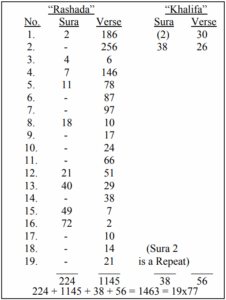
    • The word “Rashad” occurs in 40:29 & 38. The word “Khalifa” occurs in 2:30 and 38:26. The first “Khalifa” refers to a non-human “Khalifa,” namely, Satan, while the second occurrence (Sura 38), refers to a human “Khalifa.” If we  add the numbers of suras and verses of “Rashad” (40:29, 38) and “Khalifa”   (38:26) we get 40 + 29 + 38 + 38 + 26 = 171 = 19×9.
    • The sum of all sura and verse numbers where all “Rashada” and all “Khalifa” occur, without discrimination, add up to 1463, 19×77 (See table below).

    • The total of all suras and verses where the root word “Rashada” occurs is 1369, or (19×72) + 1, while the total for all occurrences of “Khalifa” is 94, (19×5)-1. The fact that “Rashada” is up by one and “Khalifa” is down by one pins down the name as “Rashad Khalifa,” and not any “Rashad” or any “Khalifa.”  
    • The gematrical value of “Rashad” is 505 and the value of “Khalifa” is 725 (Table 7, Appendix 1). If we add the value of “Rashad Khalifa” (1230) to the sura numbers, and the number of verses, from the beginning of the Quran to the first occurrence of “Rashada,” the total is 1425, 19×75.
    • If we add the numbers of all the verses in every sura, i.e., the sum of verse numbers (1 + 2 + 3 + … + n) from the beginning of the Quran to the first occurrence of the root word “Rashada,” the total comes to 17233, 19×907.
    • The Quranic Initials constitute the basic foundation of the Quran’s miracle. These initials occur in suras 2, 3, 7, 10, 11, 12, 13, 14, 15, 19, 20, 26, 27, 28, 29, 30, 31, 32, 36, 38, 40, 41, 42, 43, 44, 45, 46, 50, and 68. If we add the sum of these numbers (822) to the value of “Rashad Khalifa” (1230), the total is 2052, 19×108.
    • If we add the numbers of all suras where the root word “Rashada” occurs, plus the number of verses, we get 1368, or 19×72.
    • If we examine the suras and verses from the first occurrence of the root word “Rashada” to the word “Khalifa” in 38:26, we find that the sum of sura numbers and their numbers of verses is 4541, or 19×239.

    The Only Religion Approved by God is Islam

    [3:19]


    • The Quran specifies three messengers of Islam (Submission):

    Abraham delivered all the practices of Islam. The value of his name = 258

    Muhammad delivered the Quran. The value of his name = 92

    Rashad delivered Islam’s proof of authenticity. The value of his name = 505

    Total gematrical value of the 3 names = 855 = 19×45.

    The true Judaism, Christianity, and Islam will be consolidated into one religion—complete submission and absolute devotion to God ALONE.

    The existing religions, including Judaism, Christianity, and Islam are severely corrupted and will simply die out (9:33, 48:28, 61:9).

    Why Verse 3:81?

    • If we add the sura numbers plus the number of verses from the beginning of the Quran to Verse 3:81, where the Messenger of the Covenant is prophesied, the total comes to 380, 19×20.
    • The gematrical value of Verse 3:81 is 13148, 19×692. This value is obtained by adding the gematrical values of every letter in the verse.
    • If we look at that portion of Verse 3:81 which refers specifically to the messenger of the Covenant: “A messenger will come to you, confirming what you have,” in Arabic:

    “JAA’AKUM RASOOLUN MUSADDIQUN LEMAA MA‘AKUM”

    we find that the gematrical value of this key phrase is 836, 19×44.


    HOW TO DISTINGUISH GOD’S MESSENGER FROM A FAKE MESSENGER

    The Quran provides straightforward criteria to distinguish the true messengers of God from the false messengers:

    [1] God’s messenger advocates the worship of God ALONE, and the abolition of all forms of idol worship.

    [2] God’s messenger never asks for a wage for himself.

    [3] God’s messenger is given divine, incontrovertible proof of his messengership. Anyone who claims to be God’s messenger, and does not meet the three minimum criteria listed above is a false claimant.


    The most important difference between God’s messenger and a fake messenger is that God’s messenger is supported by God, while the fake messenger is not:

    * God’s messenger is supported by God’s invisible soldiers (3:124- 126, 9:26&40, 33:9, 37:171-173, 48:4&7, 74:31).

    * God’s messenger is supported by God’s treasury (63:7-8).

    * God’s messenger, as well as the believers, are guaranteed victory and dignity, in this world and forever (40:51 & 58:21).

    Thus, the truthfulness of God’s messenger invariably prevails, while the falsehood of a fake messenger invariably, sooner or later, is exposed.


    PRINCIPAL DUTIES OF GOD’S MESSENGER OF THE COVENANT

    As stated in the Quran, 3:81, God’s Messenger of the Covenant was predestined to confirm all the scriptures, which were delivered by all the prophets, and restore them to their original purity.

    MERCY FROM GOD [21:107]

    When the believers are faced with a problem, they develop a number of possible solutions, and this invariably leads to considerable bickering, disunity, and disarray. We learn from 2:151, 3:164, and 21:107 that it is but mercy from God that He sends to us messengers to provide the final solutions to our problems. We learn from 42:51 that God sends His messengers to communicate with us, and to disseminate new information. Hence the strong injunction in 4:65, 80 to accept, without the slightest hesitation, the teachings delivered to us through God’s messengers. The following is a list of the principal duties of God’s Messenger of the Covenant:

    The following is a list of the principal duties of God’s Messenger of the Covenant:

    1. Unveil and proclaim the Quran’s mathematical miracle.
    2. Expose and remove the two false verses 9:128-129 from the Quran.
    3. Explain the purpose of our lives; why we are here.
    4. Proclaim one religion for all the people, and point out and purge away all the corruptions afflicting Judaism, Christianity, and Islam.
    5. Unveil the end of the world.
    6. Proclaim that those who die before the age of 40 go to Heaven
    7. Explain the Quran’s delivery to, then through Muhammad.
    8. Explain why most believers in God do not make it to Heaven.
    9. Proclaim that God never ordered Abraham to kill his son.
    10. Proclaim the secret of perfect happiness.
    11. Establish a criminal justice system.
  • Un des Grands Miracles [74:35]

    Praise be to God! There is no other god except God.

    The Quran is characterized by a unique phenomenon never found in any human authored book. Every element of the Quran is mathematically composed—the suras, the verses, the words, the number of certain letters, the number of words from the same root, the number and variety of divine names, the unique spelling of certain words, the absence or deliberate alteration of certain letters within certain words, and many other elements of the Quran besides its content. There are two major facets of the Quran’s mathematical system: (1) The mathematical literary composition, and (2) The mathematical structure involving the numbers of suras and verses. Because of this comprehensive mathematical coding, the slightest distortion of the Quran’s text or physical arrangement is immediately exposed.

    Simple to Understand

    Impossible to Imitate

    For the first time in history we have a scripture with built-in proof of divine authorship—a superhuman mathematical composition.

    For example, the total occurrence of the word “God” in the Quran is 2698, or 19×142. The total sum of verse numbers for all verses containing the word “God” is 118123, also a multiple of 19 (118123 = 19×6217).

    Nineteen is the common denominator throughout the Quran’s mathematical system.

    This phenomenon alone suffices as incontrovertible proof that the Quran is God’s message to the world. No human beings could have kept track of 2698 occurrences of the word “God,” and the numbers of verses where they occur. This is especially impossible in view of (1) the age of ignorance during which the Quran was revealed, and (2) the fact that the suras and verses were widely separated in time and place of revelation. The chronological order of revelation was vastly different from the final format. However, the Quran’s mathematical system is not limited to the word “God;” it is extremely vast, extremely intricate, and totally comprehensive.

    The Simple Facts

    Like the Quran itself, the Quran’s mathematical coding ranges from the very simple, to the very complex. The Simple Facts are those observations that can be ascertained without using any tools. The complex facts require the assistance of a calculator or a computer. The following facts do not require any tools to be verified, but please remember they all refer to the original Arabic text:

    1. The first verse (1:1), known as “Basmalah” consists of 19 letters. It’s constituent words occur in the Quran consistently in multiples of 19.
    2. The first word, “Ism” (Name) occurs 19 times.
    3. The second word “Allah” (God) occurs 2698 times (19×142)
    4. The third word “Al-Rahman” (Most Gracious) occurs 57 times, 19×3
    5. The fourth word “Al-Raheem” (Most Merciful) occurs 114 times, 19×6.
    6. The Quran consists of 114 suras, which is 19 x 6.
    7. The total number of verses in the Quran is 6346, or 19 x 334. [6234 numbered verses & 112 un-numbered verses (Basmalahs) 6234 + 112 = 6346] Note that 6 + 3 + 4 + 6 = 19.
    8. The Basmalah occurs 114 times, despite its conspicuous absence from Sura 9 (it occurs twice in Sura 27) & 114 = 19 x 6.
    9. From the missing Basmalah of Sura 9 to the extra Basmalah of Sura 27, there are precisely 19 suras.
    10. It follows that the total of the sura numbers from 9 to 27 (9 +10 +11 +12 +… + 26 + 27) is 342, or 19 x 18.
    11. This total (342) also equals the number of words between the two Basmalahs of Sura 27, and 342 = 19 x 18.
    12. The famous first revelation (96:1-5) consists of 19 words.
    13. This 19-worded first revelation consists of 76 letters 19 x 4.
    14. Sura 96, first in the chronological sequence, consists of 19 verses.
    15. This first chronological sura is placed atop the last 19 suras.
    16. Sura 96 consists of 304 Arabic letters, and 304 equals 19 x 16.
    17. The last revelation (Sura 110) consists of 19 words.
    18. The first verse of the last revelation (110:1) consists of 19 letters.
    19. 14 different Arabic letters, form 14 different sets of “Quranic Initials” (such as A.L.M. of 2:1), and prefix 29 suras. These numbers add up to 14 + 14 + 29 = 57 = 19 x 3.
    20. The total of the 29 sura numbers where the Quranic Initials occur is 2 + 3 + 7 +… + 50 + 68 = 822, and 822 + 14 (14 sets of initials) equals 836, or 19 x 44.
    21. Between the first initialed sura (Sura 2) and the last initialed sura (Sura 68) there are 38 un-initialed suras. 19 x 2.
    22. Between the first and last initialed sura there are 19 sets of alternating “initialed” and “uninitialed” suras.
    23. The Quran mentions 30 different numbers: 1, 2, 3, 4, 5, 6, 7, 8, 9, 10, 11, 12, 19, 20, 30, 40, 50, 60, 70, 80, 99, 100, 200, 300, 1000, 2000, 3000, 5000, 50,000, & 100,000. The sum of these numbers is 162146, which equals 19×8534.

    This is a condensed summary of the Simple Facts.

    The Literary Mathematical Composition

    The Quran is characterized by a unique phenomenon never found in any other book; 29 suras are prefixed with 14 different sets of “Quranic Initials,” consisting of one to five letters per set. The table below shows the Quranic Initials and their suras:
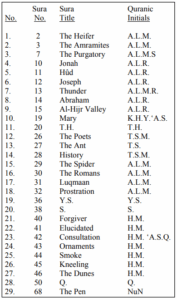
    So, fourteen letters, half the Arabic alphabet, participate in these initials. The significance of the Quranic initials remained a divinely guarded secret for 14 centuries. The Quran states in 10:20 and 25:4-6 that its miracle, i.e., proof of divine authorship was destined to remain secret for a specific predetermined interim:

    Verse 10:20 says, “They said, “Why hasn’t a miracle come down to him from his Lord?” Say, “Only God knows the future. Therefore, wait, and I will wait along with you.”

    And verse 25:4-6 says, “Those who disbelieved said, “This is no more than a fabrication by him, with the help of other people.” Indeed, they uttered a blasphemy; a falsehood. Others said, “Tales from the past that he wrote down; they were dictated to him day and night.” Say, “This was sent down from the One who knows ‘the secret’ in the heavens and the earth.” Surely, He is Forgiving, Most Merciful.”

    Historical Background

    Back in 1968, Rashad Khalifa realized that the existing English translations of the Quran did not present the truthful message of God’s Final Testament. For example, the two most popular translators, Yusuf Ali and Marmaduke Pickthall, could not overcome their corrupted religious traditions when it came to the Quran’s great criterion in 39:45, which says,

    When God ALONE is mentioned, the hearts of those who do not believe in the Hereafter shrink with aversion. But when others are mentioned beside Him, they rejoice.”

    Yusuf Ali omitted the crucial word “ALONE” from his translation, and altered the rest of the verse by inserting the word “(gods).” Thus, he utterly destroyed this most important Quranic criterion. He translated 39:45 as follows:

    “When God, the One and Only, is mentioned, the hearts of those who believe not in the Hereafter are filled with disgust and horror; but when (gods) other than He are mentioned, behold, they are filled with joy.”

    The expression “When God, the One and Only, is mentioned,” is not the   same as saying, “When God alone is mentioned.” One can mention “God, the One and Only,” and also mention Muhammad or Jesus, and no one will be    upset. But if “God ALONE is mentioned,” you cannot mention anyone else, and a lot of people—those who idolize Muhammad or Jesus—will be upset. Thus, Yusuf Ali could not bring himself to present the truth of the Quran, if it exposed his corrupted belief.

    Marmaduke Pickthall translated “ALONE” correctly, but destroyed the criterion by inserting his personal belief in parentheses; he translated 39:45 as follows:

    And when Allah alone is mentioned, the hearts of those who believe not in the Hereafter are repelled, and when those (whom they worship) beside Him are mentioned, behold! they are glad.

    So, when Rashad Khlifa saw the truth of God’s word distorted like that, he decided to translate the Quran, at least for the benefit of his own children. Since he was a chemist by profession, and despite his extensive religious background—his father was a renowned Sufi leader in Egypt—he, Rashad, vowed to God that he would not move from one verse to the next unless I he understood it.

    He purchased all the available books of Quranic translations and exegeses (Tafseer) that he could find, placed them on a large table, and began his translation. The first sura, The Key, was completed in a few days. The first verse in Sura 2 is “A.L.M.” The translation of this verse took four years, and coincided with the divine unveiling of “the secret,” the great mathematical Miracle of the Quran.

    The books of Quranic exegeses unanimously agreed that “no one knows the meaning or significance of the Quranic Initials A.L.M., or any other initials.” So, Rashad Khalifa decided to write the Quran into the computer, analyze the whole text, and see if there were any mathematical correlations among these Quranic initials.

    To test his hypothesis, he decided to look at the single-lettered Quranic Initials—“Q” (Qaaf) of Suras 42 and 50, “S” (Saad) of Suras 7, 19, and 38, and “N” (Noon) of Sura 68. As detailed in his first book MIRACLE OF THE QURAN: SIGNIFICANCE OF THE MYSTERIOUS ALPHABETS (Islamic Productions, 1973), many previous attempts to unravel the mystery had failed.

    The Quranic Initial “Q” (Qaaf)

    The computer data showed that the text of the only Q-initialed suras, 42 and 50, contained the same number of Q’s, 57 and 57. That was the first hint that a deliberate mathematical system might exist in the Quran.

    Sura 50 is entitled “Q,” prefixed with “Q,” and the first verse reads, “Q, and the glorious Quran.” This indicated that “Q” stands for “Quran,” and the total number of Q’s in the two Q-initialed suras represents the Quran’s 114 suras  (57 + 57 = 114 = 19×6). This idea was strengthened by the fact that “the Quran” occurs in the Quran 57 times.

    The Quran is described in Sura “Q” as “Majid” (glorious), and the Arabic word “Majid” has a gematrical value of 57: M (40) + J (3) + I (10) +D (4) = 57.

    Sura 42 consists of 53 verses, and 42 + 53 = 95 = 19×5.

    Sura 50 consists of 45 verses, and 50 + 45 = 95, same total as in Sura 42.

    By counting the letter “Q” in every “Verse 19” throughout the Quran, the total count comes to 76, 19×4.

    So, glimpses of the Quran’s mathematical composition began to emerge. For example, it was observed that the people who disbelieved in Lot are mentioned in 50:13 and occur in the Quran 13 times—7:80; 11:70, 74, 89; 21:74; 22:43; 26:160; 27:54, 56; 29:28; 38:13; 50:13; and 54:33. Consistently, they are referred to as

    “Qawm,” with the single exception of the Q-initialed Sura 50 where they are referred to as “Ikhwaan.” Obviously, if the regular, Q-containing word “Qawm” were used, the count of the letter “Q” in Sura 50 would have become 58, and      this whole phenomenon would have disappeared. With the recognized absolute accuracy of mathematics, the alteration of a single letter destroys the system.

    NuN (Noon)

    This initial is unique; it occurs in one sura, 68, and the name of the letter is   spelled out as three letters—Noon Wow Noon—in the original text, and is there-     fore counted as two N’s. The total count of this letter in the N-initialed sura is 133, 19×7.

    The fact that “N” is the last Quranic Initial brings out a number of special observations. For example, the number of verses from the first Quranic Initial (A.L.M. of 2:1) to the last initial (N. of 68:1) is 5263, or 19×277.

    The word “God” (Allah) occurs 2641 (19×139) times between the first initial    and the last initial. Since the total occurrence of the word “God” is 2698, it follows that its occurrence outside the initials “A.L.M.” of 2:1 on one side, and the initial “N” of 68:1 on the other side, is 57, 19×3.

    S (Saad)

    This initial prefixes three suras, 7, 19, and 38, and the total occurrence of the letter “S” (Saad) in these three suras is 152, 19×8. See Table below:
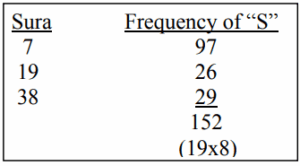
    It is noteworthy that in 7:69, the word “Bastatan” is written in some printings with a “Saad,” instead of “Seen.” This is an erroneous distortion that violates the Quran’s code. By looking at the oldest available copy of the Quran, the Tashkent Copy, it was found that the word “Bastatan” is correctly written with a “Seen” (see photocopy below).
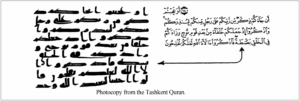
    Historical Note

    The momentous discovery that “19” is the Quran’s common denominator became a reality in January 1974, which since the revelation of the Quran is 1406 lunar years, or 19×74. This is especially uncanny in view of the fact that “19” is mentioned in Sura 74.

    Y.S. (Ya Seen)

    These two letters prefix Sura 36. The letter “Y” occurs in this sura 237 times, while the letter “S” (Seen) occurs 48 times. The total of both letters is 285, 19×15.

    It is noteworthy that the letter “Y” is written in the Quran in two forms; one          is obvious and the other is subtle. The subtle form of the letter may be confusing        to those who are not thoroughly familiar with the Arabic language. A good example is the word “Araany” which is mentioned twice in 12:36. The letter “Y” is used twice in this word, the first “Y” is subtle and the second is obvious. Sura 36 does not contain a single “Y” of the subtle type. This is a remarkable phenomenon, and one that does not normally occur in a long sura like Sura 36.

    H.M. (Ha Mim)

    Seven suras are prefixed with the letters “H” and “M”, Suras 40 through 46.  The total occurrence of these two letters in the seven H.M.-initialed suras is 2147, or 19×113. See table below:
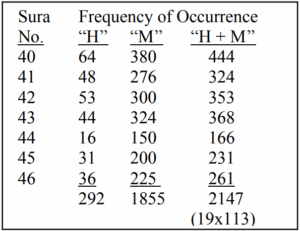
    Naturally, the alteration of a single letter “H” or “M” in any of the seven H.M.-initialed suras would have destroyed this intricate phenomenon.

    ‘A.S.Q. (‘Ayn Seen Qaf)

    These initials constitute Verse 2 of Sura 42, and the total occurrence of these letters in this sura is 209, or 19×11. The letter “ ‘A” (‘Ayn) occurs 98 times, the letter “S” (Seen) occurs 54 times,  and the letter “Q” (Qaf) occurs 57   times.

    A.L.M. (Alef Laam Mim)

    The letters “A,” “L,” and “M” are the most frequently used letters in the Arabic language, and in the same order as we see in the Quranic Initials—“A,” then “L,” then “M.” These letters prefix six suras—2, 3, 29, 30, 31, and 32—and the total occurence of them is a multiple of 19. Herein below is the occurrence of those letters counted by Rashad Khalifa:
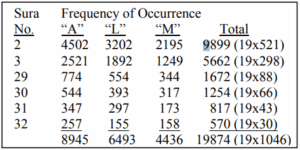
    A.L.R. (Alef Laam Ra)

    The initials A.L.R are found in Suras 10, 11, 12, 14, and 15, and they are again a multiple of 19, when you add them in all their respective suras together. Herein is the occurrence of those letters counted by Rashad Khalifa:
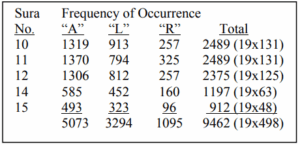
    A.L.M.R. (Alef Laam Mim Ra)

    These initials prefix one sura, No. 13, and the total frequency of occurrence of the four letters is 1482, or 19×78. The letter “A” occurs 605 times, “L” occurs 480 times, “M” occurs 260 times, and “R” occurs 137 times.

    A.L.M.S. (Alef Laam Mim Saad)

    Only one sura is prefixed with these initials, Sura 7, and the letter “A” occurs in this sura 2529 times, “L” occurs 1530 times, “M” occurs 1164 times, and “S” (Saad) occurs 97 times. Thus, the total occurrence of the four letters in this sura is 2529 + 1530 + 1164 + 97 = 5320 = 19×280.

    An important observation here is the interlocking relationship involving the  letter “S” (Saad). This initial occurs also in Suras 19 and 38. While complementing its sister letters in Sura 7 to give a total that is divisible by 19, the frequency of this letter also complements its sister letters in Suras 19 and 38 to give a multiple of 19.

    Additionally, the Quranic Initial “S” (Saad) interacts with the Quranic Initials “K.H.Y. ‘A.” (Kaaf Haa Ya ‘Ayn) in Sura 19 to give another total that is also a multiple of 19. This interlocking relationship—which is not unique to the initial “S” (Saad)—contributes to the intricacy of the Quran’s numerical code.

    K.H.Y.‘A.S. (Kaaf Ha Ya ‘Ayn Saad)

    This is the longest set of initials, consisting of five letters, and it occurs in one   sura, Sura 19. The letter “K” in Sura 19 occurs 137 times, “H” occurs 175 times, “Y” occurs 343 times, “ ‘A” occurs 117 times, and “S” (Saad) occurs 26 times.   Thus, the total occurrence of the five letters is 798, which is 19×42.

    T.H. (Ta Ha), T.S. (Ta Seen), T.S.M. (Ta Seen Mim)

    An intricate interlocking relationship links these overlapping Quranic Initials to produce a total that is also a multiple of 19. The initial “H.” is found in Suras 19 and 20. The initials “T.H.” prefix Sura 20. The initials “T.S.” are found in Sura 27, while the initials “T.S.M.” prefix its surrounding Suras 26 & 28. The frequencies of occurrence of these initials are found in the table below:
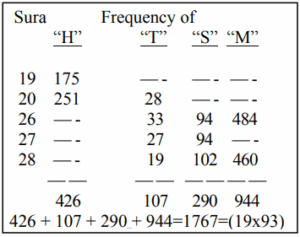
    These are the only sets 0f initials which are combined in the count to produce a multiple of 19. Nevertheless, none of them give multiples of 19 individually. Almost 50 years later, Alban Fejza was destined to discover and explains why these three sets of initials (T.H., T.S., T.S.M.) are the only initials which should not give multiples of 19 when counted individually, which is given in Alban Fejza’s explanatory review of the Mathematical Miracle of the Quran.

    What Is A “Gematrical Value”?

    When the Quran was revealed, 14 centuries ago, the numbers known today did not exist. A universal system was used where the letters of the Arabic, Hebrew, Aramaic, and Greek alphabets were used as numerals. The number assigned to each letter is its “Gematrical Value.” The numerical values of the Arabic alphabet are shown in the table below:
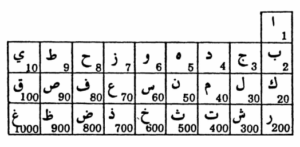
    Other Mathematical Properties of the Initialed Suras

    Fourteen Arabic letters, half the Arabic alphabet, participate in the formation of 14 different sets of Quranic Initials. By adding the gematrical value of each one of these letters, plus the number of suras which are prefixed with Quranic Initials (29), we obtain a total of 722, or 19x19x2. Additionally, if we add the total gematrical value of all 14 initials, plus the number of the first sura where the initial occurs, we get a grand total of 988, 19×52. See table below for both counts:
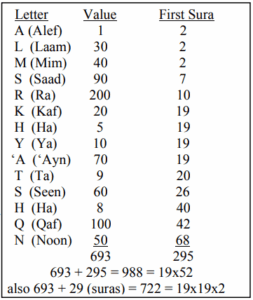
    WHY   19!

    The number 19 can be looked upon as the Almighty Creator’s signature on everything He created. The number “19” possesses unique mathematical properties. For example:

    1. It is a prime number, which are the only numbers which can be used for such coding, since they are not multiples of other numbers.
    2. It encompasses the first numeral (1) and the last numeral (9), as if to proclaim God’s attribute in 57:3 as the “Alpha and the Omega.”

    We now understand that the universal coding of God’s creations with the number 19 rests in the fact that it is the gematrical value of the word “ONE” (WAHD) in all the scriptural languages—Aramaic, Hebrew, and Arabic. See table below:
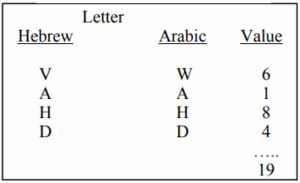
    The number 19, therefore, proclaims the First Commandment in all the scriptures: that there is only ONE God.
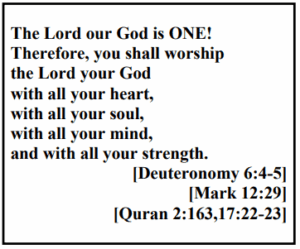
    The word “ONE” that refers to God occurs in the Quran 19 times. The reference to God “ALONE” occurs 5 times, and the sum of the sura and verse numbers where we find these five occurrences is 361, 19×19.

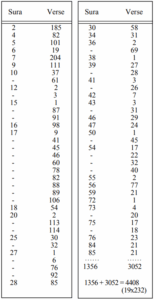
    The “First Pillar of Islam” is stated in 3:18 as “LAA ELAAHA ELLA HOO” (There is no other god besides Him). This most important expression occurs in 19 suras. The first occurrence is in 2:163, and the last occurrence is in 73:9. The total of these sura numbers, plus the number of verses between the first and last occurrences, plus the sum of these verse numbers is 316502, or 19x 16658.

    The Word “Quran”

    The word “Quran” occurs in the Quran 58 times, with one of them, in 10:15, referring to “another Quran.” This particular occurrence, therefore, must be excluded. Thus, the frequency of occurrence of “this Quran” in the Quran is 57, or 19×3.

    Two other grammatical forms of the word “Quran” occur in 12 verses. These include the word “Quranun” and the word “Quranahu.” One of these occurrences, in 13:31 refers to “another   Quran” that cause the mountains to crumble. Another occurrence, in 41:44, refers to “a non-Arabic Quran.” These two occurrences, therefore, are excluded. The table below shows a list of the suras and verses where the word « Quran » in all its grammatical forms, occurs.
    A Witness From the Children of Israel [46:10]

    Verse 46:10 in the Quran says, “Say: “What if it is from God, and you disbelieved in it? A witness from the Children of Israel has borne witness to a similar phenomenon, and he has believed, while you have turned too arrogant to believe. God does not guide the wicked””

    The following quotation is taken from STUDIES IN JEWISH MYSTICISM, (Association for Jewish Studies, Cambridge, Mass., Joseph Dan & Frank Talmage, eds., Page 88, 1982). The quotation refers to the work of Rabbi Judah the Pious (12th Century AD):

    The people [Jews] in France made it a custom to add [in the morning prayer] the words: “ ’Ashrei temimei derekh [blessed are those who walk the righteous way],” and our Rabbi, the Pious, of blessed memory, wrote that they were completely and utterly wrong. It is all gross falsehood, because there are only nineteen times that the Holy Name is mentioned [in that portion of the morning prayer]… and similarly you find the word ’Elohim nineteen times in the pericope of Ve-’elleh shemot. . . . Similarly, you find that Israel were called “sons” nineteen times, and there are many other examples. All these sets of nineteen are intricately intertwined, and they contain many secrets and esoteric meanings, which are contained in more than eight large volumes… Furthermore, in this section there are 152 (19×8) words.

     

  • Pour les mathématiciens

    Pour les mathématiciens


    Mathematics is the most exact science of all sciences – it is the perfect epitome of science. However, some semi-professional mathematicians have managed to introduce in the modern books of mathematics confusions which are causing problems with students when they try to understand mathematics. And there are three main issues in mathematics which need to be clarified:

    1. “IMAGINARY” NUMBERS
    2. INFINITY
    3. THE FUNDAMENTAL AXIOM OF MATHEMATICS.

    By the way, especially because of the fundamental axiom of mathematics mentioned in part 3, this is the most important article in the history of mathematics. But let’s deal with the less important part first, which has to do with the so called “imaginary numbers”.


    1: IMAGINARY NUMBERS

    The so-called IMAGINARY NUMBERS are denoted with an “i” in mathematics. Whomever discovered them called them ‘imaginary’ because he thought that he was simply using a dirty trick to solve Quadratic Equations, without realizing that they really existed.

    The question arises, “If they are not real, how come they always work?” As a matter of fact, let’s give examples of why the so called ‘imaginary’ numbers are just as real as the real numbers.

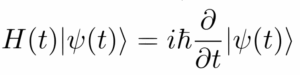
    This ‘i’ (for ‘imaginary’) is found all over the equations of quantum mechanics which is the basis of modern physics. For example, the Schrodinger Equation has an ‘i’ in it:

    Also, the Dirac Equation, has an “i” in it:

    So, can you call physics imaginary, which are things which we can touch?

    As a matter of fact, Paul Dirac predicted the existence of antimatter simply using this ‘i’ and guess what, today we know that antimatter does exist. It exists in small quantities in the observable universe, and it’s also being produced artificially in high energy accelerators in many labs around the world.

    So, in fact, the so-called ‘imaginary’ numbers are real numbers in a perpendicular dimension, which can be a real physical hyper-dimension, like the 4th dimension and 5th dimension, as predicted by Einstein’s Theory, or all the way to the 10th dimension as predicted by String Theory).

    So, the ‘i’ is not imaginary at all. It works. How can you call something which always works ‘imaginary’. Equations which deal with electricity have the so called imaginary numbers, and you can try and touch electricity and see if it’s real or imaginary. However, it’s not the mission of this article to fix the books of mathematics, so we can still use the “i” in all the books of mathematics, but the correct way to call them would be to call them “invisible numbers” instead of “imaginary numbers”, because the so called imaginary numbers are real numbers but they are invisible numbers which exist in a perpendicular direction.

    In the Quran, this is expressed by verses 69:38-39, which say, “I swear by what you see, and what you do not see”


    2: INFINITY

    In many well established books of mathematics, you can find the expression:

    1+2+3+4+…=-1/12

    What they are saying is that if we add all the numbers from 1 all the way to infinity, we will get -1/12.

    This value can be reached through the Ramanujan Summation, or the Rieman Zeta Function Regularization, or Analytical Continuation, but in fact none of these methods are pure mathematics. When we use some of these methods, which deal with divergent series, or other things which have implied infinities in them, we are assuming that we can count all the way to infinity, surpass it, come back to zero, and then and only then we would get the value -1/12, for example. But, we already know that we can not count all the way to infinity, so by using these methods, we are assuming something which is not possible. Therefore, adding all the numbers all the way to infinity does not equal to -1/12.

    Mathematics is the science of counting, and if you can not count to infinity, it means that Infinity is beyond mathematics. Infinity does not bend to the rules of mathematics, but it is mathematics which bends to the rules of Infinity.

    And this can be indirectly implied from many verses in the Quran:

    [19:94] He has encompassed them, and has counted them one by one.

    [72:28] This is to ascertain that they have delivered their Lord’s messages. He is fully aware of what they have. He has counted the numbers of all things.

    [57:3] He is the Alpha and the Omega. He is the Outermost and the Innermost. He is fully aware of all things.

    [78:29] We counted everything in a record.

    [70:3] From GOD; Possessor of the highest Height.

    [40:15] Possessor of the highest ranks, and Ruler of the whole dominion. He sends inspiration, bearing His commands, to whomever He chooses from among His servants, to warn about the Day of Summoning.

    [2:15] GOD mocks them, and leads them on in their transgressions, blundering.

    And really all the crazy attempts to manipulate with Infinity emerge from the fact that mathematicians do not know, or take for granted the fundamental axiom of mathematics, which is explained below.


    3: THE FUNDAMENTAL AXIOM OF MATHEMATICS

    Now, let’s get introduced to the fundamental axiom of mathematics. It can be called “THE AXIOM OF EXCLUSIVE IDENTITY”. According to this axiom, each number has an exclusive identity. For example, number 2 is exclusively 2. 3 is exclusively 3. So,

    There is no other 3 except for 3.

    There is no other 4 except for 4.

    There is no other 5 except for 5.

    There is no other 6 except for 6.

    There is no other 5000 except for 5000.

    Even if we write these numbers in two places, the number which was written in one place and the one which were written in another place are still the same number. It’s not two different 3s for example, but only one number 3 exists. Number 3 is the same in the other side of the world, it’s even the same outside of this universe, at another time, in another place, it doesn’t matter, it’s the same 3. That’s why when we add 3 to 4 it always gives us 7, because it’s the same 3 and the same 4. So two different 3s do not exist. So 3 is exclusively 3. It’s not 4, it’s not 5, it’s not another 3, it’s the same 3. Likewise:

    There is no other 4 except for 4.

    There is no other 5 except for 5.

    There is no other 6 except for 6.

    There is no other 5000 except for 5000.

    There is no other 1,000,000 except for 1,000,000.

    And there is no other Infinity except for Infinity.

    So, using the Axiom of Exclusive Identity we can reach the conclusion that:

    There is no other Infinity except for Infinity.

    And here is why this is important. It’s important because using this axiom, when we face the problems arising from Ramanujan Summations, for example, it will be very easy to understand. Here is an example:

    Let’s say we try to add the numbers 1+2+3+4+5+…+∞, and this is known to be equal to ((∞+1)*∞)/2. However, once we see that the expression suggests that there will be 1 added ∞ (infinity), then we immediately recognize that it would be another infinity which would be bigger than the previous infinity, which would suggest that there are two infinities. However, this violates the fundamental axiom of mathematics, because according to it, there can be only one infinity. So, this means that the solution to this problem does not exist. So admitting that the fundamental axiom of mathematics supersedes the other rules of mathematics, leads us to the correct conclusion. However, had we applied the rules of mathematics even in cases where they violate the fundamental axiom of mathematics, then we could get the wrong results, while not being aware that we have crossed the boundaries of what mathematics can do. So, the solution to the expression 1+2+3+4+5+…+∞ is simply beyond mathematics.

    CONCLUSION:

    EVERYTHING is within the scientific scope of mathematics, except for Infinity.

    And it is an axiom which extends all the way to INFINITY. This is how we express it in mathematical language, but in religious language, it is expressed in the Quran in many verses like:

    [57:3] He is the Alpha and the Omega. He is the Outermost and the Innermost. He is fully aware of all things.

    [3:18] GOD bears witness that there is no god except He, and so do the angels and those who possess knowledge. Truthfully and equitably, He is the absolute god; there is no god but He, the Almighty, Most Wise.